
There are 10,000 galaxies worth of neural connections in our brains; how do these connections create our consciousness and allow us to perceive the world around us?
As humans, our ability to process information and think about the world around us has been one of our greatest assets. To see our world and make sense of it is a complex task that is unique to us, and through studying and research we have been able to determine how our brain and the minds of many other organisms work. However, there are many parts to our minds and consciousness that are still a mystery today.
In the PBS NOVA documentary Your Brain: Perception Deception, viewers are introduced to the complexities of human perception and the ways in which our brains gather, process, and interpret information from the world around us to construct our reality. Throughout the process of constructing our reality, neurons in our brains transfer inputs to electrochemical signals when we use our senses, determining what we process and store in our brains, and what ultimately becomes an edited version of our reality. As humans, we only capture about 1% of the information that we sense, combining the strongest signals that we capture and filling in the rest based on our peripheral vision and any additional information we were able to gather with our senses. Our brains were built to capture just a thumbnail of what we can see at any given time for our survival: we take in quick pieces of our reality and fill in the blanks with our peripheral vision, allowing us to quickly process information within our brains to make split-second decisions. This perception of our world is individual to each person, forming what is known as our own consciousness.
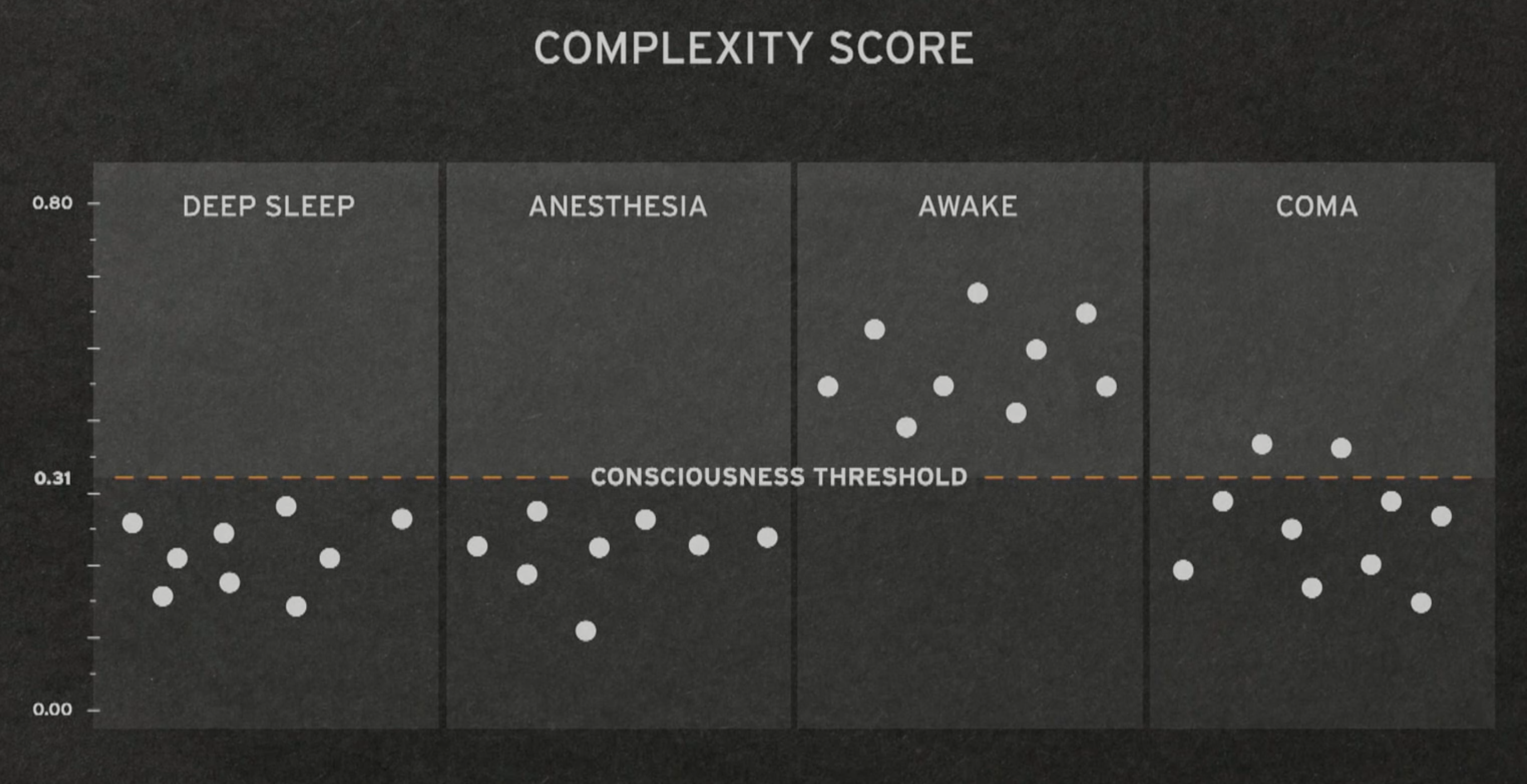
As the documentary defines it, consciousness is our simulation and awareness of the world. Consciousness is about the overall state of awareness and experience, with perception as one aspect of consciousness, creating a subjective understanding of our existence and the world around us. In other words, perception is “the process of becoming aware of physical objects [or] phenomena…through the senses” while consciousness is “the state of being aware of and responsive to one’s surroundings” (OED.com). Our consciousness is an internal experience that is unique to each person, and it derives from neurons and signals going off within our brains when we are responding to our environment. The documentary shows new technology to test consciousness within the medical field, using devices to scan the brain and measure its activity of unresponsive patients. By seeing if the brain is active, doctors can see if the patient is responding to their surroundings and using what they are perceiving through their senses.
The documentary thoroughly explains the way our brain works during conscious perception where we are using our senses to understand the world around us, and thus responding to the information we gather. Some of the ideas of perception explained throughout the documentary included the ways color works in our brain through the example of the “blue and black versus white and gold” dress that became a viral sensation in 2015, and how our brain fills gaps of uncertainty when listening to audio messages, such as in the “yanny vs. laurel” sound example. Through perception and processing this information, as explained in the documentary, different parts of the brain communicate, creating our conscious perception. One element of this phenomenon that is missing an in-depth explanation in the documentary is what our consciousness looks like and is doing while we are asleep. Since many people dream and are experiencing some mental activity while sleeping, there may be neurons and signals going off to create dreams, therefore creating our consciousness. However, if we are not physically perceiving information through our senses while we sleep, are we actually conscious? There is still some information missing as to what our consciousness levels look like while we sleep and what the physical “consciousness threshold” is, as seen in the image above.
Overall, the idea of consciousness and how we perceive the information that allows us to be conscious is a complex phenomenon that continues to be developed and explored every day. With every person experiencing the world around us differently through our unique use of our senses and varying amounts of information processed in our brains, the realities we experience may be different, yet the fascinating organ and connections that provide us the ability to perceive and be conscious is what unites us all.
References and Credits:
Quoted information from the Oxford English Dictionary definitions of perception and consciousness. (OED.com)
Information in italics above was taken from the results of ChatGPT text when prompted “simple explanation of the difference between perception and consciousness.”Results from ChatGPT prompt:
Perception refers to the way we interpret and make sense of the world around us through our senses, like sight, hearing, taste, smell, and touch. It’s about how our brain processes sensory information to create a mental representation of reality.
On the other hand, consciousness is the state of being aware of ourselves, our thoughts, feelings, and experiences. It’s the subjective awareness of our existence and the world around us, including our perceptions. While perception is more about interpreting sensory input, consciousness is about the overall state of awareness and experience. In essence, perception is one aspect of consciousness, but consciousness encompasses a broader range of mental activities beyond perception.
Information in title of post above was taken from the ¬results of ChatGPT text when prompted “catchy blog post title about consciousness and what we understand about it.”
Results from ChatGPT prompt:
“Mind Matters: Illuminating Insights into Consciousness”