
You may have looked up close to your computer and see the pixels across the screen, but what makes each pixel show a different color and how are images displayed?
Pixels are the smallest element of a digital image, acting as the building block for all things digital. Each pixel shows only one color at a time and can multiply in the number of pixels depending on the increase in resolution of the image.
The colors that the pixels show varies depending on the number of bits for each pixel, also known as “color depth”. In digital imaging, color depth refers to the number of bits used to represent the color of each pixel in an image. A higher color depth allows for a wider range of colors to be represented, resulting in more detailed and accurate images.
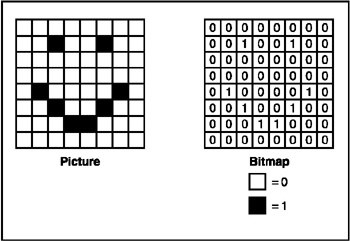
The smallest color depth a pixel can have 1 bit, which can only vary between a 0 and a 1, or two colors represented. A 0 represents the absence of a color or pixel, and a 1 represents the presence of a color or pixel. As seen in the image above, when a bitmap, or a grid of pixels, includes a 1 in a single bit pixel, the pixel is black. When there is a 0 in the pixel, the corresponding color is white. In a binary, single bit pixel of a digital image, there are only two colors that can be shown, represented as either a 0 or 1.
As the color depth of pixels increases, more colors are available for the pixel to represent. In an 8-bit color depth, each pixel is represented by 8 bits, or one byte. In computer screens, phones, TVs, and other digital devices, projected colors are created with a variation of red, green, and blue colors. One byte of this color depth represents one number between 0 and 255 for either red, green or blue. By using three bytes, a combination of red, green and blue bytes can create over 16 million color combinations that the pixel can represent. This combination is referred to as a “256-color” mode as there are 256 color options for each of the three bytes. By increasing the color depth and number of bits in each pixel, more colors can be represented.
One of the highest color depths of an image is in a 48-bit per pixel bit depth. This configuration can create a combination of nearly three-hundred trillion colors, producing detailed images at high resolutions. This bit/color depth is used within space telescopes to collect large amounts of data of all possible colors that the human eye is incapable of seeing on its own.
Because each pixel represents only one color, the resolution and color depth of the digital image are important in creating a more detailed and colorful image. In images with small color depths and low resolutions, there are only two colors that can be used and a small field of pixels, making detailed images difficult to represent. By having an image with a large color depth and a high resolution, more variations in colors are available and more detail can be shown as there are more pixels compiling the image.
In digital representation, when zooming in on an image the individual pixels of color can be seen, losing the detail of image and showing how there are limitations in the amount of colors that can be used. Since the number of bits determines the available number of colors, not all colors are available in digital imaging as opposed to “natural” representation of images.
Overall, the number of colors each pixel represents is important in composing a digital image. With larger color depths, a greater variation in color combinations is created as opposed to a smaller color depth that varies between only two colors. Pixels are the building block of our digital world, and by understanding the bits of 0s and 1s of each pixel we can create a wide range of colors and combinations for complex and detailed images.
Credits:
Information in italics above was taken from the results of ChatGPT text when prompted “do pixel colors vary depending on the number of bits in each pixel.”
Results from ChatGPT prompt:
Yes, the number of bits used to represent each pixel directly impacts the range of colors that can be displayed for that pixel. This concept is commonly referred to as “color depth” or “bit depth.”
In digital imaging, color depth refers to the number of bits used to represent the color of each pixel in an image. A higher color depth allows for a wider range of colors to be represented, resulting in more detailed and accurate images.