
Learning Objective #4: Explain the advantages and limitations of a digital representation in a historical as well as modern context.
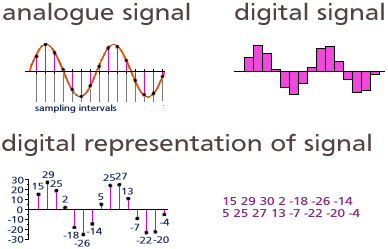
Digital representation uses symbols and signals that can be easily identified, such as the letters of the alphabet or distinguishing between 0s and 1s in a binary code. Digital signals allow for precise calculations and identifiable results, as opposed to continuous analog signals that cannot be identified as easily. There are a fixed number of possibilities and symbols in digital signals, creating clear results that limit errors or confusion for users.
Advantages of Digital Representation in History:
- Ancient hieroglyphics
- People were able to draw a letter and identify what they were trying to communicate, proving the definitive symbols in a digital language where users can tell the difference between signals for clear results. For example, people viewing the letters can distinguish between the letter A and the letter B as they are drawn differently, eliminating confusion between the two symbols and uncertainties about what others are trying to communicate.
- Legibility of historical writing or sheet music
- As letters of the alphabet and numbers are digital symbols, we can understand what authors like Shakespeare and composers of music like Beethoven from centuries ago intended to write in their work through the identifiable letters and symbols they used.
- 1838 – Samuel Morse and Alfred Vail developed the telegraph with the use of Morse code
- Morse code is a digital language that produces a sequence of dots and dashes to represent each letter of the alphabet, numbers, and some punctuation marks through the electronic device of a telegraph. Morse code allows for users to send precise and identifiable messages by inputting a sequence of signals into the device to represent each symbol, allowing the receiver to accurately interpret the symbols they receive or correct any errors in the transmission process.
- 1945 – The first digital computer, Electronic Numerical Integrator and Computer (ENIAC), was completed
- This device was used after the Norden Bombsight, an analog computer, failed to produce accurate results for bombings during World War II. The analog computer was made of thousands of individual parts that created inaccuracies, and as the device was used, these inaccuracies added and multiplied together to produce incorrect results. The ENIAC was a digital computer later completed during World War II that solved many of the issues of analog computers. This digital computer showed the importance of using digital computations to produce exact, precise, repeatable results where users could see the errors made in calculations and fix them along the way.
- 2009 – The Federal Communication Commission initiated the transition from analog to digital televisions
- This transition to digital TVs allowed for more channels to become available and smaller dishes to receive the frequencies of different stations to be used. Digital TVs eliminated static and noise from weak signals as the signal for digital TVs were one of two options – available or not.
Limitations of Digital Representation in History:
- Digital representation relies on bandwidth, or bits per second, to transmit information. The bandwidth of devices represents how many symbols that can be sent in a second, therefore more bandwidth is needed to send more signals or units per second.
- As digital symbols can be easily identified, encryption issues and hiding messages becomes more difficult as others can identify the symbols being communicated.
- Constant improvements and complicated devices are needed to produce new digital technologies.