
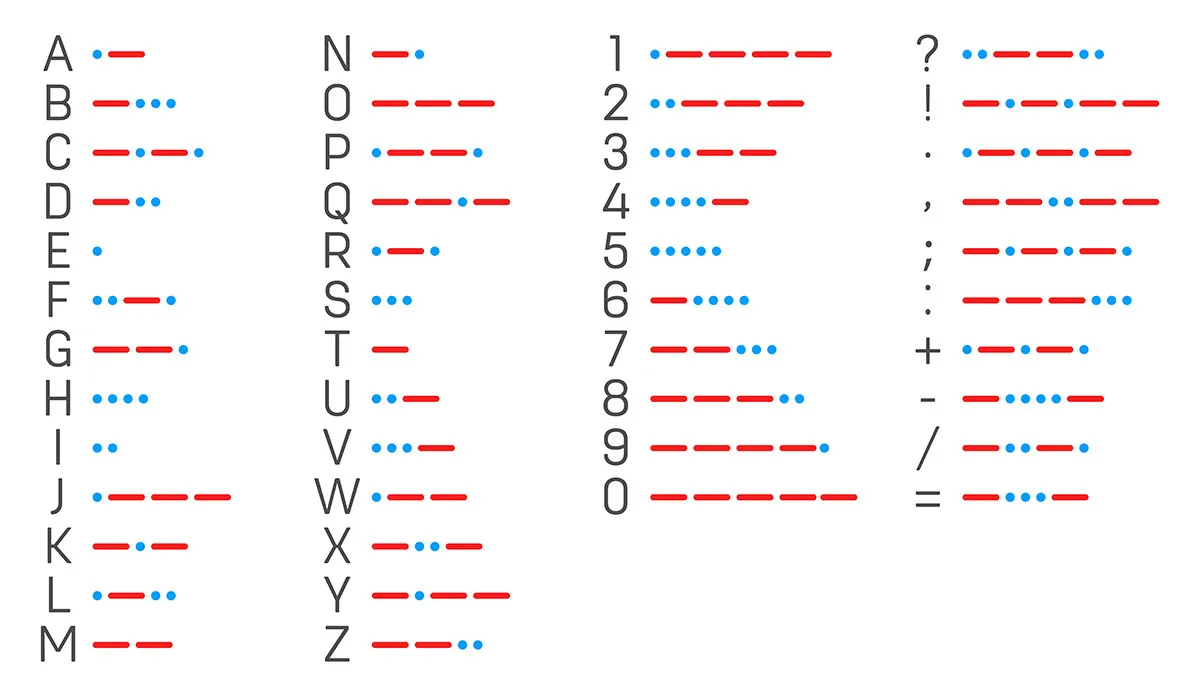
You may have heard the quick sounds or seen flashing lights for Morse code, but what do these signals mean and how are they used in the telegraph?
Morse code was first developed through the invention of the telegraph by Samuel Morse and Alfred Vail in early 1838. Samuel Morse was a well-known painter at the time but became an inventor after some tragic news. Morse received a letter that his wife was ill, but by the time he could get to her, she had already passed away and was buried. Morse wanted to find a way to communicate information faster than having to rely on the long journey for messages carried by people, horses, or boats.
Morse and Vail developed the electric telegraph as a way of point-to-point messaging to send and receive information without the physical transmission of messages. Other versions of the telegraph were invented previously by other inventors and scientists, however these devices lacked important technology or technical parts to make them work, and they did not consider the human experience of using the devices. The telegraph transmits encoded text messages over long distances using electrical signals, but the messages that the device transfers needed to be quick and easy for the receiving person to understand. Some systems for messages were first created to associate the number of beeps that the device produced with a letter of the alphabet, such as one beep for the first letter, A, or 26 beeps for the last letter, Z. This method of coding letters took a long time to signal entire words or sentences and it left some confusion for users trying to distinguish between letters and the number of beeps they received. Other devices also used separate keys for each letter of the alphabet that would be connected to their own wire and signal for each individual letter, however these wires were harder to spread over long distances and the devices were more difficult to use.
Morse wanted to create a different coding system that used quick and identifiable signals of dots and dashes in short sequences to represent the letters of the alphabet, numbers, and some punctuation marks, which is what we now know as Morse code. This language replaced all keys of previous telegraph designs with just one key and device for people to use. Morse also considered the human experience and abilities of people to learn a new simple language of dots and dashes to spread these quick messages rather than relying on a complex machine or writing out a long sequence of letters and signals.
Morse and Vail’s telegraph worked by inputting messages into a transmitter to send electrical signals through a wire and to the receiver at the other end. With this device, a wire could span nearly 25 miles from one sender, or operator, to a receiver who then sent the message through another device over 25 additional miles, repeating the chain of communication until the message reached its final destination. This hopping of messages and relaying of information from one person to the next left some room for errors and inaccuracies in the messages to be presented, however because the device is a digital system these errors can be detected and corrected to relay the correct message.
The telegraph was first demonstrated to Congress in 1842 and after some convincing of how the device could change the world, the telegraph was used across the country and eventually connected the east and west coasts of the U.S. in 1861. The device was particularly useful during times of war to spread messages, causing thousands of miles of wire to be made for more communication across the country and the world, and it increased the speed and reliance of journalism, allowing for journalists to share real-time information with others.
The telegraph was one of the most widely used forms of communication for decades until the telephone was invented by Alexander Graham Bell in 1876, which matched electrical patterns to human speech patterns to create an even more popular form of communication.
Morse and Vail’s development of the telegraph and invention of Morse code were some of the most important advancements in the technology we use to communicate with each other today. The telegraph with the language of Morse code created quick, easy, and reliable signals that catapulted our speed and abilities for communication.
Credits:
Information in italics above was taken from the results of ChatGPT text when prompted “what is a telegraph.”
ChatGPT was also used to proofread this blog post.